Welcome to SYBERA ...

... the company for hardware based software and training. The mission of SYBERA is development of realtime software for Windows, network solutions and fieldbus communication (e.g. EtherCAT, ProfiNET, SERCOS III). Based on the X-Realtime technology SYBERA offers realtime software tools for industrial automation. The SYBERA training center offers developer seminars on the subjects to Kernel software ( kernel mode device driver and integration ), realtime control and fieldbus communication for the operating systems Windows ( Windows 7, VISTA, XP, 2000, CE, Embedded ). SYBERA disposes of modern classrooms and offers internal as well as external training.
 
        Products Training Contact

Trainingscenter


Products

WDM Driver Development
WDF Driver Development
USB Driver Development
NDIS Driver Development
Windows Embedded
EtherCAT Development
PROFINET Development
SERCOS III Development
PCI and PCI Express
Systembased Programming
CANBus Development
Training, Schulung, WDF, WDM, USB, Treiber, Driver
 
realtime, rtx, extension, ethercat, profinet, master
SHA X-Realtime
Realtime Ethernet Core
Realtime CANBus Core
Realtime Serial Core
Windows EtherCAT Master
Windows ProfiNET Master
Windows SERCOS III Master
Realtime MODBus Master
X-GO Logic Control
KernelScope
 

SYBERA GmbH, Hohenzollernstr.2, 71088 Holzgerlingen, Germany, Tel: ++49-7031-744-608 (Fax: -609), EMail: info@sybera.de


Overview

With the event driven RTX system the realtime task always is called, when the event comes true (compare periodic event). In this case the latency time must be less than the periodic latency of the event. The latency time is depending on the priority distribution of the interrupts. With the periodic realtime scheduling the realtime task is being called periodically. In this case the cycle period must be less than the periodic latency of the event.

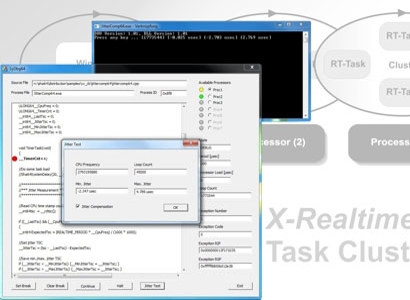
X - Realtime allows non-preemptive interprocess multitasking. Conventional realtime subsystems usually work with a scheduler mechanism for the realtime task, which usually shows a high time deviation due to the system. The X - Realtime Engine works with separate clock sources which leads to a clearly better JITTER behavior and thereby realizes a complete detachment of the realtime-task to the existing operating system. With the X - Realtime Engine, realtimetask cycles are realizable upto 10 µsec (100 KHz) sampling rate. An integrated watchdog system controls the realtime task and determines the remaining tasktime. The SHA X - Failsafe System offers additionally the possibility to keep a rescue task busy or to proceed a controlled shutdown, even on heavy exception errors (for example Blue-Screen). With the X - Failsafe System, for example a robot can be driven out from a hazard zone and an alarm signal is caused.

Basic of the SHA software is the realtime subsystem, called XMP-Realtime-Engine. With the new XMP-Realtime-Engine, SYBERA opens a new dimension to the realtime control under Windows XP/2000/NT. With support of multiprocessor-platforms, the realtime behaviour is clearly improved and the overall-performance was increased. On this occasion, the new XMP-Realtime-Engine exclusivly reserves a physical or logical processor for the realtime operation. Besides pure multiprocessor platfroms also the INTEL hyperthreading technology of the PentiumIV processor is fully supported.

The subsystem is asynchronously coupled with ist on scheduler clock, so that both systems (SubSystem and OS) are working almost independently. The lock mechanism of multiprocessor control is administered internally, so that the existing SHA-Interface remains unchanged. Additionally the system supports APIC interrupt control and switches automatically into the right operating mode. A further implemented mechanis is called Virtual Code Mapping. This mechanism allows placing a realtime routine or a interruptservice routine inside any application-project. These routines will be decoded and mapped to the SHA subsystem at runtime.

Conventional realtime-subsystems usually work with a synchronized schedulermechanism for realtime subsystem and OS, which usually shows a bad jitter behaviour at high OS load. The X-Realtime Engine works asynchronously with separated clock sources that clearly leads to a better jitter behavior and thereby realizes a complete decoupling of realtime-task to the existing operating system. With the X-Realtime Engine, realtime task cycles are realizable upto 10 µsec (100 KHz) sampling rate. An integrated watchdog-system controls the realtime task and determines the remaining task-time. The SHA X-Failsafe-System offers additionally the possibility to keep a rescue task busy or to proceed a controlled shutdown, even on heavy exception errors (for example Blue-Screen). With the X-Failsafe-System, for example a robot-arm can be driven out from a hazard zone and an alarm signal is caused. The realtime routine has to be equal to a RING0 EXECUTION routine for interrupt control (see Interrupt Access Module), however without a return value and it‘s not depending on the system load. With the X-Realtime routine the same programming methods and restrictions are valid like on each other RING0 EXECUTION routine. With the X-Realtime system several tasks can be programmed within an application or within a device driver and will be automatically mapped to the X-Realtime system layer at runtime. Every task can be setup with its own scheduling cycle which interacts independently to any other task cycles. Additionaly each task can given and changed its own priority dynamically. So several applications with their own realtime tasks can run at once. Together with application task also device drivers can setup their own realtime tasks to run within the X-Realtime system.

The idea of further abstruction of the SHA X-Realtime interface for several communication channels and bus systems, like serial communication, CANBUS, Serial, Ethernet (TCP/IP) is realized by SYBERA AddOn software libraries (Realtime Cores). All Realtime Core libraries are based on the SHA X-Realtime technology. The RealtimeCores are intended to fullfill Realtime Level1, which means collecting and buffering data in realtime without loss of data, as well as Realtime Level2, which means the functional operation with data. Thus the Realtime Cores usually require simple passive harware.
The AddOn realtime library "Ethernet Realtime Core" allows sending and receiving of Ethernet frames, as well as the functional operation of data in realtime. The library supports the common Windows SOCKET interface. The "Ethernet Realtime Core" is based on the "INTEL Pro" and "REALTEK" PCI- and PCMCIA-Adapter and will be installed as an NDIS NIC driver.
The AddOn realtime library "CANBus Realtime Core" allows sending and receiving of CANBus telegrams in realtime. The "CANBus Realtime Core" is based on the SJA1000 chip. The Realtime Core supports the PCI and PCMCIA adapters of PEAKSystem, IXXAT, EMS and SYBERA.
The AddOn realtime library "Serial Realtime Core" allows handling of COMM port data in realtime. Incoming data will be collected and stored in a Ringbuffer. Outgoing data will be written exactly scheduled to the communication port. The library supports the common Windows COM interface and allows easy adjustment of serial communication parameters. The "COM Realtime Core" supports the PC internal, as well as the external serial interfaces (QUATECH and OXFORD, PCI- and PCMCIA- Adapter) and will be installed as PORT driver.

The new RealtimeStudio of Sybera offers a complete solution for realtime development under Windows based on the X-Realtime technology. The RealtimeStudio comprises not only the development software with the Realtime-Engine but includes also all AddOn-Bibliotheken for Realtime-Serial-Communication, Realtime-Ethernet, Realtime-EtherCAT and Realtime-CAN for fieldbus communication. The product suitcase contains the complete documentation for the development as well as all sample packs. Also new components are the SYBERA debugger and the Realtime-Sequenzer, which allow SourceCode-Debugging and Line-Sequencing within the realtime tasks. The KernelScope software component is a tool, which analyses hard- and software events in realtime, from the physical occurence to the software handling in the application. With the RealtimeStudio, the entry into realtime development under Windows clearly becomes more simple.

In cooperation with the Robert Bosch GmbH, SYBERA has developped an EtherCAT realtime master based on the XRealtime technology. The software runs under Windows 2000 and XP, and allows realtime control of EtherCat slaves, for example the EtherCAT modules of Beckhoff GmbH. According to the PC-hardware and application, cycle times of 50µsec can be realized. The physical binding will be established with a common INTEL Pro adapter, REALTEK PCI or PCMCIA adapters.
The Open EtherCAT Realtime Master is based on the Ethernet Realtime Core and allows controlling of EtherCAT Slave-Devices. SYBERA provides therefore a library called ECATCORE for mastering the EtherCAT states and sending and receiving of EtherCAT telegrams in realtime. The Library provides an HighLevel and a LowLevel Interface witch allows handling of EtherCAT data in realtime, without the need of an complex EtherCAT management, nevertheless with the ability of interfacing all EtherCAT functionality levels.
The EtherCAT Master System is based on 4 Realtime Tasks, for sending (TX) and receiving (RX) of EtherCAT frames, error handling and the realtime application task for logical station operation. The tasks are syncronized by an internal
state machine. Thereby the error task recognizes framing errors and hardware latencies. The error task checks if a response of a transmit telegram has been received in time, and wether the working count of the receiving telegram matches the sent telegram or differs.
One or more EtherCAT telegrams are embedded in an ethernet frame. On sending the Realtime Core pops the EtherCAT telegrams from the EtherCAT interface stack and build them inside an ethenet frame. On receiving the EtherCAT telegrams will be extracted from the ethernet frame and pushed to the EtherCAT stack.
Usualy device information is provided by a corresponding XML configuration file. Since the development of software with the EtherCAT Master Library has special needs for programming, the XML file must be parsed and translated into a native format. Therefore the EtherCAT Master Library provides a configuration file called ECATDEVICE.PAR, whitch is located in the directory \windows\system32 after installation. The ECATDEVICE.PAR is a text based file with sections for Product Code, Name, SYNC Manager, FMMU Manager, SDO and Data Description.
The EtherCAT Verifier Software is a powerful software to check and configure EtherCAT devices, without the need of programming. The Software guides interactively through all devices states and configuration steps and gives useful hints for programming. The Application ECATVERIFY is based on the Realtime EtherCAT Master Library and uses its exported functionality. To start its first required to init the realtime core and the ethernet transport layer. Therefore the NIC adapter (which is realtime connected) has to be selected, as well as the base realtime period and eventually the scheduling count of the realtime application task (usually set to 1)

SYBERA offers a ProfiNET Master for ProfiNET devices. This master library allows the RT control of ProfiNET IO devices. Based on the increasing requirements of networking within the industrial area, the ethernet communication plays a more and more important role for the control of devices. Different ethernet standards are available for the bus related communication, like SERCOS, Powerlink, EtherCAT and PROFINET. The communication principle rested characteristically on a deterministic process data-exchange and requires therefore for control and devices deterministic Soft- and hardware.
The direct control of the field bus devices with a PC and the operating system windows became relevant with the introduction of so-called realtime extensions. An example therefor is the realtime extension of SYBERA that enables ethernet update cycles upto 50 µsec. The Ethernet based bus-communication differs not only through a different protocol-specification, but rather also through the bus-topology. While EtherCAT realizes a ring-topology, PROFINET realizes a star topology. While EtherCAT enables the typical Master/Slave-principle between control and devices, PROFINET consists of a provider/Consumer-model, which allows changing roles. The PROFINET realtime communication prefaces a defined Master/Slave-relation. Similar to the EtherCAT master, SYBERA calls the new PROFINET stack a PROFINET master. With the new realtime PROFINET master the necessity of a separate controller-hardware falls. The PROFINET control can be realized simply by the PC by standard Ethernet adapters. The PROFINET master is offered as an open realtime library system and enables the developer for programming of a deterministic control applications for PROFINET devices.
The SYBERA ProfiNET Master library allows the RT control of ProfiNET IO devices. The Open Master Library is based on the Ethernet Realtime Core. SYBERA provides therefore a library called SHAPNIOCORE for mastering the ProfinetIO states and sending and receiving of ProfinetIO frames in realtime. The Open ProfinetIO Realtime library allows handling of ProfinetIO data in realtime, without the need of an complex ProfinetIO management, nevertheless with the ability of interfacing all ProfinetIO interface levels.
The ProfinetIO Library is based on 4 Realtime Tasks, for sending (TX) and receiving (RX) of ProfinetIO frames, error handling and the realtime application task. The tasks are syncronized by an internal state machine. Thereby the error task recognizes framing errors and hardware latencies.
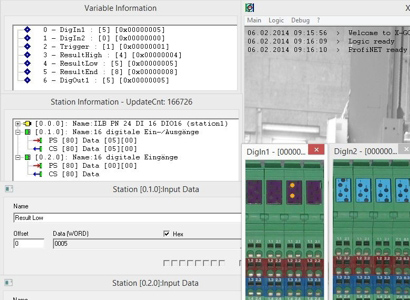
A ProfinetIO fieldbus system consists of several station devices (typically buscoupler devices). A station consists at least of one module (SLOT) and a module consists at least of one submodule (SUBSLOT). For proper operation the ProfinetIO devices needs first to be configured and a STATIONLIST must be created. Therefore SYBERA provides a program called STATIONGEN. STATIONGEN allows creating a stationlist by selecting modules from a module catalog. The catalog get its entries by the provides GSDML files. A module is inserted to the station list configuration.

The first time that SYBERA has developed a TCP Realtime Master for MODBus as extension to the existing Realtime Ethernet Core. The Realtime Master allows the deterministic control of MODBus telegrams over a closed TCP/IP communication network. This master library is comfortably realized for programming of MODBus telegrams.
The communication principle rested characteristically on a deterministic process data-exchange and requires therefore for control and devices deterministic Soft- and hardware. The MODBus TCP Realtime Master allows the deterministic control of MODBus telegrams over a closed TCP/IP communication network. This has been realized by a deterministic controlled Master/Slave handshaking. All TCP messages are controlled by a special developed TCP realtime state machine. Thereby the TCP connect, as well as the realtime controlled TCP disconnect is realized in realtime. The realtime master allows a star based network connection of MODBus participants, whereby the MAC- and IP-Adress of the buscoupplers are used for separation.
The direct control of the field bus devices with a PC and the operating system windows became relevant with the introduction of so-called realtime extensions. An example therefor is the realtime extension of SYBERA that enables ethernet update cycles upto 50 μsec. The Ethernet based bus-communication differs not only through a different protocol-specification, but rather also through the bus-topology. While EtherCAT realizes a ring-topology, MODBus TCP realizes a star topology. Similar to EtherCAT, MODBus TCP enables the typical Master/Slave-principle between control and devices. The MODBus TCP realtime communication prefaces a defined Master/Slave-relation.With the new realtime MODBus TCP master the necessity of a separate controller-hardware falls. The MODBus TCP control can be realized simply by the PC by standard Ethernet adapters
The master library is comfortably realized for programming of MODBus telegrams. SYBERA provides therefore a library called SHAMODTCP for mastering the MODBus TCP states and sending and receiving of MODBus TCP frames in realtime. The Open MODBus TCP Realtime library allows handling of MODBus TCP data in realtime, without the need of an complex MODBus TCP management, nevertheless with the ability of interfacing all MODBus TCP interface levels. The MODBus TCP Library is based on 4 Realtime Tasks, for sending (TX) and receiving (RX) of MODBus TCP frames, error handling and the realtime application task. The tasks are syncronized by an internal state machine. Thereby the error task recognizes framing errors and hardware latencies.